
Custom Rubber Mold Manufacturing Services
At Temco Rubber, we design, engineer, and machine high-precision industrial molds for custom elastomeric products. Our in-house manufacturing division covers the entire lifecycle of your tooling—translating initial 2D drawings and 3D models into robust multi-cavity production molds that adhere to strict dimensional tolerances.
Consult a Tooling Specialist
Critical Engineering Tooling Standards
A high-quality molded component is a direct result of meticulous mold engineering. Our design engineers optimize every tool configuration using advanced simulation software.
Shrinkage Calculations
Depending on Shore hardness and curing parameters, elastomers exhibit linear shrinkage of 2% to 4%. We calculate precise scaling values in-house to secure tight tolerance compliance.
Strategic Venting
Improper venting accumulates trapped air, causing burn marks or voids. Our molds integrate strategic micro-channels and venting bridges to allow air escape during material injection.
Flash & Parting Line Control
Precise land design and parting line placement prevent excessive flash overflow. Our molds secure zero-flash production, reducing secondary deflashing costs.
In-House Tooling & Machining Division
We do not outsource tool construction. Temco Rubber machines all mold cores and cavities in our specialized CNC tooling shop. Utilizing multi-axis vertical machining centers and high-precision Wire EDM cutting, we shape mold cavities out of premium steel alloys optimized for high clamping forces and thermal stability.
- Machined from premium tooling steel for maximum tool longevity and cycle counts
- Sub-micrometer cavity surface polishing prevents demolding damage
- Integrated hot/cold runner manifolds engineered to reduce compound waste
- Modular mold bases support quick-change interchangeable cavity inserts
Engineered Mold Classifications
We design and manufacture molds tailored for specific hydraulic press systems and production methodologies to achieve the perfect balance between tooling cost and piece price.
Compression Molds
Designed for traditional, high-pressure hydraulic presses. Raw compound pre-forms are placed directly into open cavities. Highly cost-effective tooling investment, ideal for oversized parts, heavy-duty dampeners, and low-to-medium series production runs.
Transfer Molds
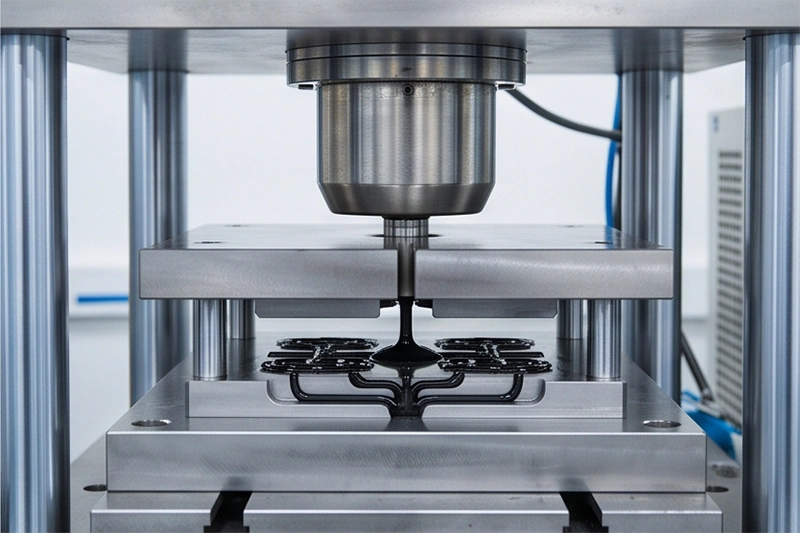
Features an integrated transfer chamber (pot) and plunger. The material is pressurized and forced through sprues into closed cavities. Ideal for detailed configurations, delicate multi-insert overmolding, and rubber-to-metal bonding assemblies.
Injection Molds
High-end multi-cavity molds engineered with precision gates, cold runner blocks, and cooling channels. Best suited for high-volume automated contract manufacturing, delivering extremely fast cycle times and maximum dimensional consistency.
Tooling & Moldmaking FAQ
Get answers to critical technical questions regarding tooling longevity, mold releases, and in-house steel machining capabilities.