Choosing a silicone rubber grade involves more than selecting a color or nominal hardness. Shore A hardness describes resistance to indentation under a defined test method. It is useful for comparing elastomers, but it does not directly specify compression set, tensile strength, tear strength or long-term seal performance.
This guide explains how to read Shore A values, how durometer testing works, and which other information engineers should supply when requesting a custom silicone part.
What is Shore A hardness?
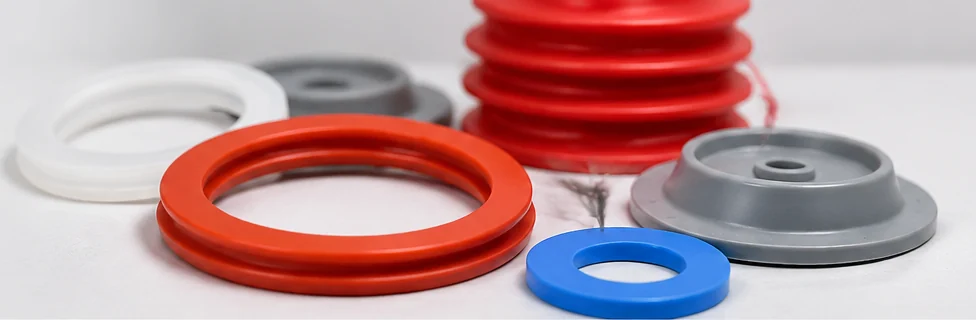
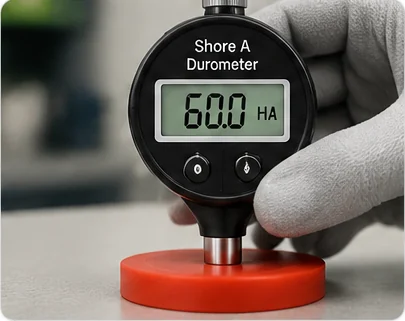
Shore A is an empirical indentation-hardness scale used for many elastomers. A lower number generally indicates a softer material and a higher number a firmer one. It is measured with a durometer following a standardized procedure.
For instance, nominal 30 Shore A silicone is typically softer in indentation than nominal 70 Shore A silicone, but a specification must identify the test method and conditions. The result does not, by itself, tell us whether either material is suitable for a particular seal.
How is Shore A measured?
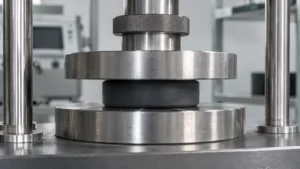
A durometer uses an indenter and controlled applied force. Test readings can be affected by specimen thickness, support, surface condition, temperature and the time after application. Measurements therefore need standardized methods and qualified specimens.
Relevant standards include ISO 48-4:2018 and ASTM D2240-15(2021). Confirm the version required by the buyer or drawing before testing or reporting compliance.
Shore A, Shore D and very soft elastomers
Shore A is commonly used for ordinary elastomeric compounds. Shore D is intended for harder materials, while other scales can be appropriate for very soft gels. Values from different scales are not directly interchangeable.
What hardness range is available in silicone rubber?
Silicone elastomers are available across a broad range of grades. The WACKER materials guide lists a Shore A range of approximately 3–90 for the grades included in its overview. This is a supplier-specific overview, not a universal promise of Temco Rubber inventory or production capability.
Terms such as soft, medium and firm are relative. Do not interpret generic tables as material recommendations for a particular product without checking actual grade data.
How hardness affects the design of silicone parts
Gaskets and washers
Material compliance influences how a gasket conforms to mating surfaces. The right material also depends on squeeze, joint stiffness, contact media, temperature and sealing pressure.
O-rings
Hardness is one consideration in groove design and extrusion risk. Groove geometry, pressure, temperature and material compatibility must be evaluated together.
Diaphragms and bellows
Flexibility may matter, but hardness alone does not determine fatigue life or resistance to tearing under repeated movement.
Keypads and molded controls
Hardness is one contributor to tactile feel, alongside geometry, actuation design and other material properties.
Hardness versus compression set
These are different tests. A Shore A value quantifies indentation resistance; compression set assesses recovery after sustained compression. Two silicone grades of equal hardness can have different compression-set values.
For critical sealing programs, consider a separate compression-set requirement with its test temperature, duration, deformation and acceptance limit.
HCR and LSR both offer hardness options
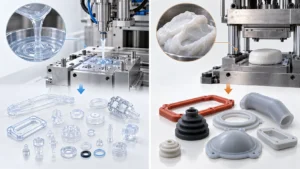
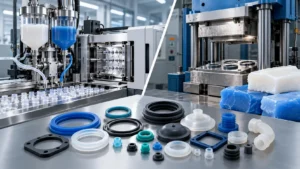
High Consistency Rubber (HCR) is a solid silicone rubber processed by routes such as compression, transfer, suitable injection molding and extrusion. Liquid Silicone Rubber (LSR) is a two-component material processed with specialized mixing and injection equipment. Neither manufacturing route is defined by Shore A hardness alone.
See our LSR vs HCR silicone comparison for additional process and material-selection considerations.
Engineering checklist before requesting a quote
- Required Shore A value and permitted tolerance, if known
- Test standard and measurement requirements
- Drawing, nominal dimensions and critical tolerances
- Service temperature, pressure, fluids and UV exposure
- Compression set, tear and tensile requirements where relevant
- Intended production volume and sampling plan
Discuss your custom silicone component
For a component-specific evaluation, Temco Rubber can review the geometry, application requirements, material needs and production route using a drawing or sample. Material availability and any special compliance claims must be verified for the selected grade.
Visit custom silicone parts manufacturing to discuss your project and request a feasibility review.
Frequently asked questions
Is 40 Shore A silicone soft?
It is generally softer than 60 or 70 Shore A silicone on the same scale, but suitability depends on the application.
Is a higher hardness always stronger?
No. Tensile strength, tear strength, compression set and other characteristics are separate properties.
Can two materials with the same Shore A perform differently?
Yes. Formulation and curing influence properties beyond indentation hardness.
Is hardness enough to choose an O-ring?
No. Groove, pressure, temperature, contact media and other mechanical requirements must also be considered.
Technical references
WACKER Chemie AG, Solid and Liquid Silicone Rubber: Material and Processing Guidelines (6709en/10.25), pp. 17 and 19; ISO 48-4:2018; ASTM D2240-15(2021). All images are illustrative unless specifically identified otherwise.