When a silicone gasket remains clamped between two mating surfaces, it may not return fully to its original thickness after the load is removed. This retained deformation is called compression set. Understanding it helps engineers compare rubber compounds for seals, washers, O-rings, and other components that spend long periods under compression.
A lower compression-set result generally indicates better recovery under the stated test conditions. It does not, on its own, prove that a seal will work in every assembly, fluid, pressure, or temperature environment.
What is compression set in silicone rubber?
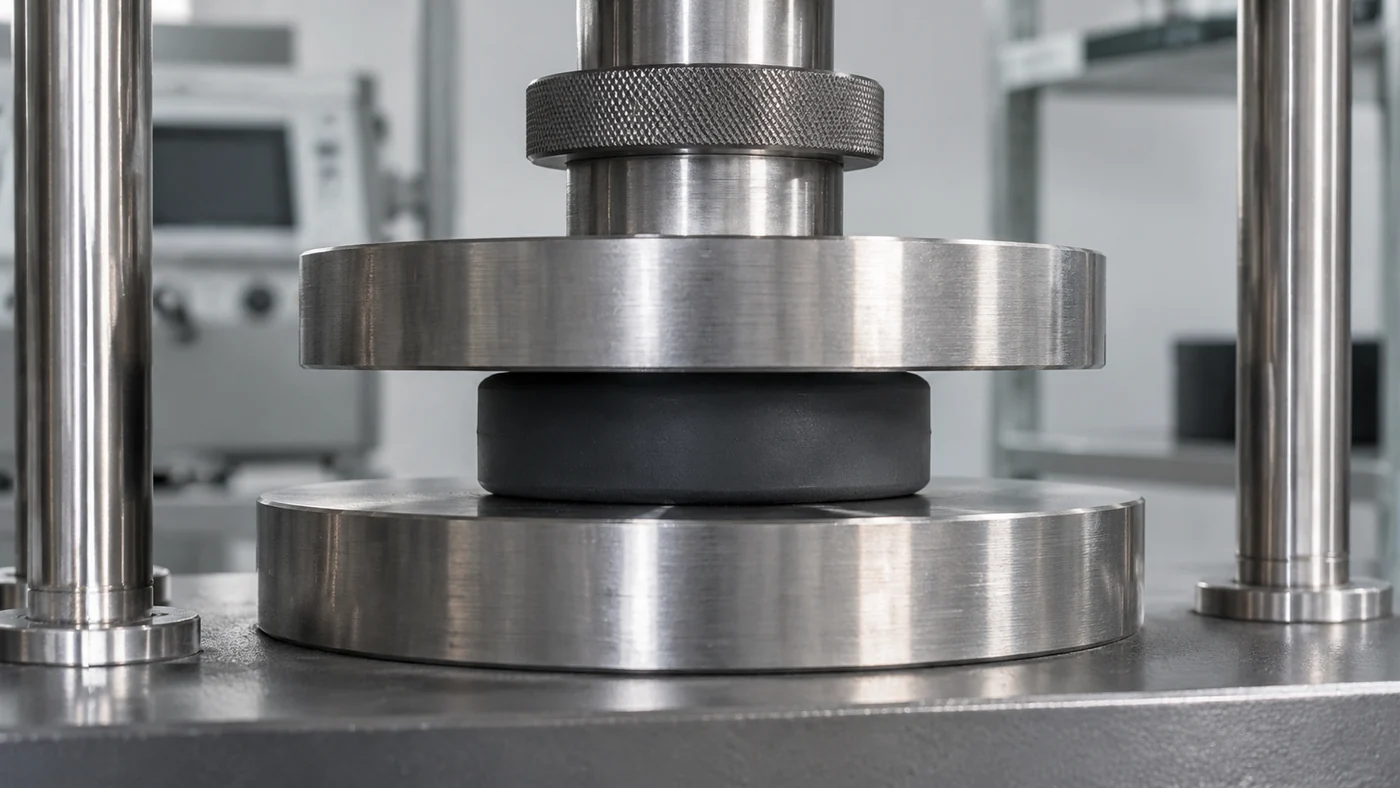
Compression set measures the deformation remaining in a rubber specimen after compression for a prescribed period and recovery under defined conditions. For a gasket, elastic recovery is relevant because a sealing interface must retain sufficient contact under actual service conditions.
How is compression set calculated?
When the test uses a fixed spacer, the usual expression is:
Compression set (%) = [(t₀ − tᵣ) / (t₀ − tₛ)] × 100
- t₀: original specimen thickness
- tᵣ: recovered thickness after the specified recovery period
- tₛ: spacer thickness during the test
As an illustrative example, a specimen originally 10.0 mm thick is compressed to 7.5 mm and later recovers to 9.0 mm. Its compression set is (10.0 − 9.0) / (10.0 − 7.5) × 100 = 40%. This is a worked example, not a measured property of a Temco material.
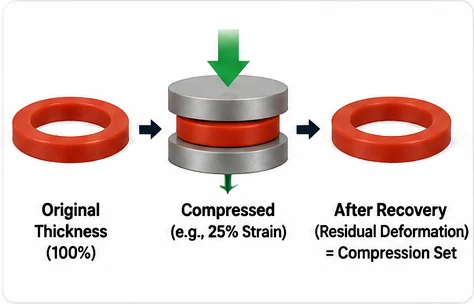
How is compression set tested?
ISO 815-1:2019 describes determination of compression set for vulcanized and thermoplastic rubber at ambient or elevated temperatures. Specimen preparation, deformation, time, temperature and recovery conditions must be controlled and reported. Results from different conditions must not be compared as though they were directly interchangeable.
When reviewing a supplier datasheet, check the whole test condition—not only the percentage. The WACKER guide discusses measurements at 22 hours and 175 °C for selected elastomers and illustrates the effect of post-curing on certain grades. These values are examples in a supplier guide, not universal requirements for all silicone compounds.
Why compression set matters for gaskets and O-rings
Sealing depends on material behavior and the joint design together. Geometry, initial squeeze, flange stiffness, temperature, contact media, surface condition, pressure and assembly variation can all affect sealing performance.
A permanently deformed gasket may have less ability to accommodate changes in the gap between mating surfaces. Conversely, a low compression-set result alone does not guarantee sealing success: a poorly designed gland or incompatible material can fail despite a favorable laboratory number.
Six factors that influence silicone compression set
1. Compound formulation
Base polymer, filler system, crosslinking chemistry and other ingredients affect mechanical properties. Two compounds with the same nominal hardness can have different compression sets.
2. Initial cure
Crosslinking conditions influence the cured network. Inadequate process control can affect repeatability and final properties.
3. Post-curing
For some silicone grades, post-curing can lower compression set and remove volatiles. WACKER demonstrates a pronounced material-specific effect for ELASTOSIL LR 3003/50; it also identifies grades designed for low compression set without post-curing. Never generalize the improvement to every material.
4. Temperature
Higher temperatures can accelerate changes in rubber properties. Compare data measured at a condition relevant to the intended service environment.
5. Deformation and geometry
The imposed compression and the specimen or part thickness affect test interpretation, curing and thermal history.
6. Time and exposure
A short laboratory test is a useful screening measure, but it is not a direct prediction of multiyear service life.
Compression set is not the same as Shore A hardness
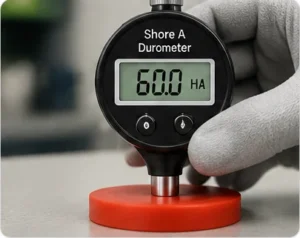
Shore A hardness is an indentation-hardness measurement; compression set measures recovery after sustained deformation. A firmer compound is not automatically the better seal. Specify both properties when the design requires them, and consider tensile strength, tear resistance and compatibility as well.
What should an engineer specify for a custom silicone seal?
- 2D drawing or 3D CAD model, critical dimensions and mating surfaces
- Application, operating temperature and contact media
- Intended compression or gland configuration and pressure conditions
- Hardness and relevant mechanical-property requirements
- Required compression-set test method, temperature, duration and acceptance criteria
- Expected quantity, inspection needs and sample-approval plan
Before tooling, consider a silicone mold design and tooling review. The part geometry and its inspection plan matter alongside material properties.
Custom silicone parts for sealing applications
Temco Rubber reviews custom silicone component projects using drawings, physical samples and stated operating requirements. Selection of compound and manufacturing route is subject to project-specific feasibility review; no universal compression-set value is promised.
Explore custom silicone parts manufacturing if you are developing a gasket, washer, O-ring or other molded sealing component.
Frequently asked questions
Is a lower compression-set percentage always better?
Under comparable test conditions, a lower result generally means better thickness recovery. Other mechanical, chemical and geometric requirements remain important.
Does post-curing always improve compression set?
No. Its effect is grade- and process-specific. Use the compound supplier’s recommendations and validate finished-part properties.
Can two Shore A 50 silicone compounds have different compression sets?
Yes. Hardness alone cannot establish compression set or seal suitability.
Which standard is used?
ISO 815-1:2019 is one commonly used standard for tests at ambient or elevated temperatures.
Technical references
WACKER Chemie AG, Solid and Liquid Silicone Rubber: Material and Processing Guidelines (6709en/10.25), pp. 17 and 66–68; ISO 815-1:2019. Figures in this article are illustrative and not Temco test data.